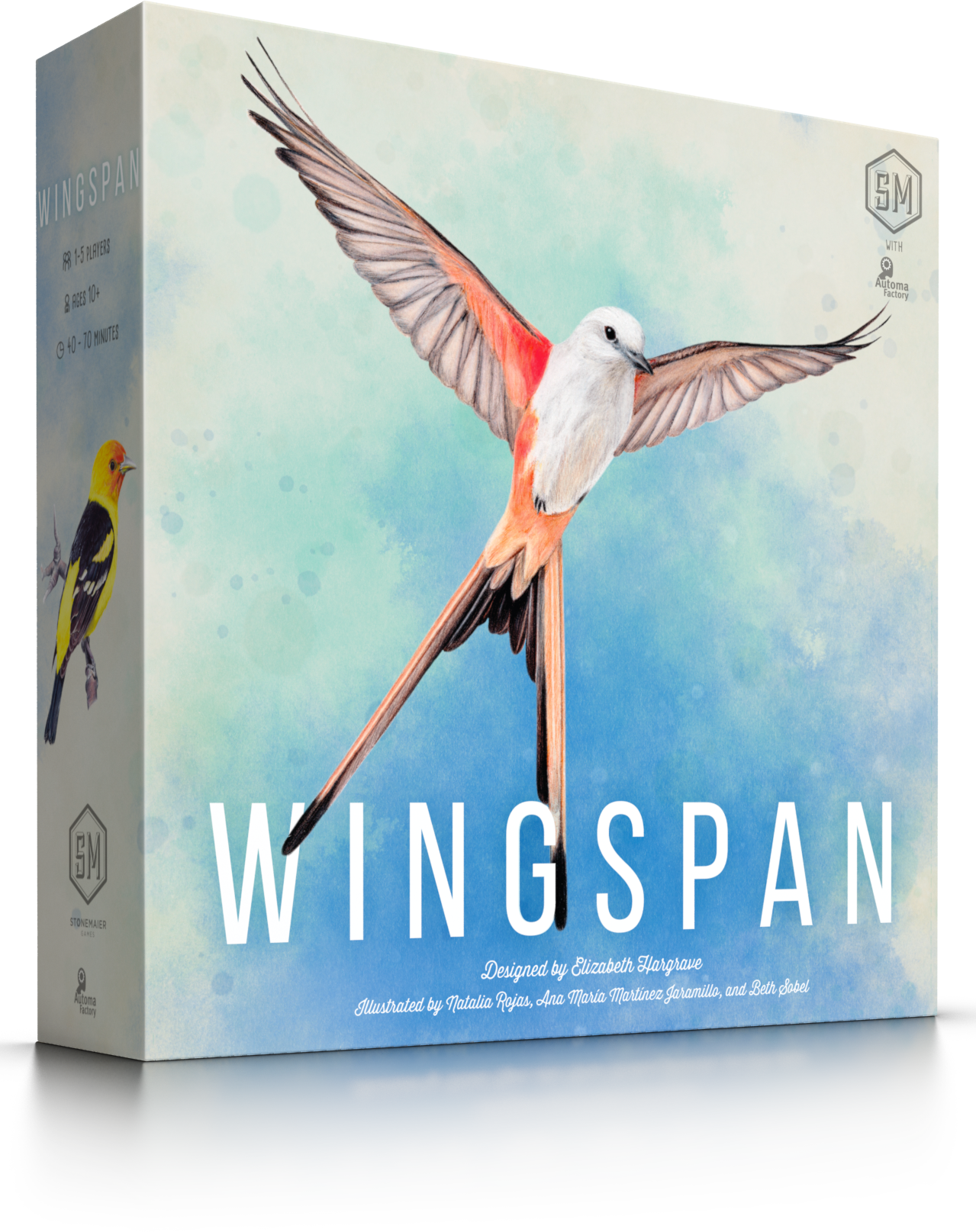
Wingspan
Wingspan is a competitive, medium-weight, card-driven, engine-building board game.
You are bird enthusiasts—researchers, bird watchers, ornithologists, and collectors—seeking to discover and attract the best birds to your network of wildlife preserves. Each bird extends a chain of powerful combinations in one of your habitats: forest, grassland, or wetland.
The winner is the player with the most points after 4 rounds.
Quick Reference
ON YOUR TURN — choose ONE action:
1. PLAY A BIRD — pay its food + egg cost, place in matching habitat.
2. GAIN FOOD — take food from birdfeeder, plus activate forest 'when activated' powers.
3. LAY EGGS — place eggs on bird cards, plus activate grassland powers.
4. DRAW BIRD CARDS — draw cards, plus activate wetland powers.
Each habitat gives more rewards as you play more birds in it (left-to-right).
ROUND END: score the round-end goal on the goal board.
GAME END: after Round 4. Score: birds + bonus cards + end-of-round goals + eggs + food on cards + tucked cards.
Components 10
Bird cards
The main deck. Each card is a unique bird with VP, habitat, food cost, egg capacity, and a power.
Bonus cards
Personal end-game scoring objectives drawn at setup.
Goal tiles
End-of-round goals slotted into the goal board.
Food dice
Custom dice with five food types and a wild 'invertebrate + seed' face. Live in the birdfeeder tower.
Egg miniatures
Pastel egg pieces placed on bird cards.
Food tokens
Cardboard tokens for each of the five food types.
Player mats
One per player, with rows for forest, grassland, and wetland.
Action cubes
8 per player color; placed on the player mat to take actions.
Birdfeeder dice tower
Cardboard tower; food dice are rolled into it.
First-player token
Wooden tracker passed each round.
Setup Instructions 6 steps
How to Win
The player with the most total victory points after 4 rounds wins.
If tied, the player with the most food in their personal supply wins. Still tied? Most unused eggs. Still tied? Shared victory.
On Your Turn
Turn structure
-
Play a bird
Pay the food and egg costs shown on the bird card. Place it in the matching habitat row, leftmost open slot. Trigger any pink (when played) power.
-
Gain food
Place an action cube in the forest row. Take food dice from the birdfeeder equal to your row reward, then re-roll the tower if it's empty or has only one type.
-
Lay eggs
Place an action cube in the grassland row. Distribute eggs equal to your row reward across your birds (max capacity printed on each card).
-
Draw bird cards
Place an action cube in the wetland row. Draw bird cards equal to your row reward — from the face-up tray and/or the deck.
Available actions
Play a bird
Food + eggs (varies)Adds a bird to your tableau — your engine grows.
Gain food
1 action cubeTake food from the birdfeeder; activate forest powers right-to-left.
Lay eggs
1 action cubeLay 2-5 eggs depending on grassland progress; activate grassland powers.
Draw cards
1 action cubeDraw 1-3 cards from face-up tray or the deck; activate wetland powers.
Scoring 6
End-game scoring
Sum the upper-left VP value on every bird in your preserves.
Reveal each bonus card and score per its instructions (e.g. 'Wingspan ≥ 65 cm: 1/2/4/7 birds = 2/5/9/14 VP').
Each egg on any of your birds is worth 1 point.
Each food token cached on a bird (via its power) is worth 1 point.
Each bird card tucked under another bird is worth 1 point.
Round / phase scoring
Look at the goal board: most/fewest in a category scores per the column shown that round.
Resources 6
How to Play 3
At 1 player (Automa) you have 8/7/6/5 cubes per round; at 2-5 players the same.
-
On your turn, take exactly ONE of the four actions, then play passes to the next player.
Explanation:Wingspan never has multi-action turns — that's why a single round is short.
Common Mistakes:Don't try to do two things at once like in heavier engine builders.
-
A round ends when every player has used all of their action cubes for that round.
Explanation:Players have fewer cubes available in later rounds (8/7/6/5 actions across rounds 1-4).
Common Mistakes:Forgetting that round 4 is shorter — plan your engine timing.
-
After every player passes, score the end-of-round goal, then start the next round.
Some birds activate every time you take an action in that habitat. Others trigger only when played.
-
Pink (When Played) powers trigger once, immediately when the bird is placed.
Explanation:Read the card carefully — pink is one-time only.
Common Mistakes:Forgetting to use the pink power before passing the turn.
-
Brown (When Activated) powers trigger every time you take the matching habitat action, in right-to-left order.
Explanation:Always activate from rightmost bird leftward — order matters.
Common Mistakes:Activating left-to-right and missing food→egg combos.
-
White (Once Between Turns) powers trigger when an opponent does something specific.
Explanation:Stay alert during opponents' turns — these powers are easy to miss.
Common Mistakes:Letting opponents' turns slide by without checking your white powers.
-
After round 4 is scored, total VP from: birds, bonus cards, all 4 end-of-round goals, eggs, food cached on cards, and tucked cards.
Explanation:Use the scorepad — it has a column for each category.
Common Mistakes:Forgetting to count cached food and tucked cards (often 5–10 hidden VP).
Variants & House Rules 3
Bird powers that target opponents (steal food, force discards) are ignored in this mode. Recommended for kids and first-timers.
Play against an AI driven by a small deck. Great for learning the game and engine practice.
Instead of dealing 5 random cards, deal 8 to each player and draft 1 / pass / draft 1 until each has 5. Adds strategic opening.
Official Errata 1
When a pink power lets you play another bird, that bird's pink power also triggers, but you do NOT activate brown powers — the original action was 'play a bird', not the matching habitat action.
Tips & Strategies 6
Read your bonus card BEFORE choosing which 5 starting birds to keep — it dictates 50% of your strategy.
Don't ignore one habitat. Even 2-3 birds in each unlocks the better column rewards.
Brown 'when activated' powers stack — placing them right-to-left in their row is a trap. Place them left-to-right so they trigger every action from then on.
Eggs are flexible currency — they pay for high-VP birds, satisfy bonus cards, and score 1 VP each at end of game.
Tucking and caching are quiet VP factories — a 'tuck 2' bird run 3 times is 6 hidden points.
Reset the bird tray (top action) when it's full of expensive birds you can't use — fresh cards are usually better.
Common Mistakes 6
Forgetting to activate brown 'when activated' powers right-to-left.
Playing birds without checking if their food cost can come from cached food (some powers spend cached food).
Spending all your eggs on bird costs and having nothing to score with at end of game.
Ignoring the end-of-round goal until it's too late to compete for it.
Re-rolling the birdfeeder when 4 of 5 dice match — you give opponents the same reset.
Tucking cards under birds without realizing it removes them from the deck (they don't go back).
Glossary 7
- Tuck
-
Slide a bird card under another bird (usually face-down) to count as +1 VP and to satisfy 'tucked' powers.
- Cache
-
Place a food token on a bird via its power. Cached food is worth 1 VP each at game end.
- Habitat
-
One of the three rows on your player mat: forest (food), grassland (eggs), wetland (cards).
- Activate
-
Trigger a brown power. Always go right-to-left in the active row.
- Wingspan
-
The literal wingspan in cm printed on each bird card — used by some bonus cards.
- Predator
-
A bird with a 'predator' icon; some powers and bonus cards reference predator status.
- Birdfeeder
-
The dice tower holding the 5 food dice. Re-roll when only one food type remains or it's empty.
Frequently Asked 5
No. Once you place your last cube, you're done for the round and pass for the rest of it.
Only if the play-a-bird action's pink power says so. Brown powers trigger on the corresponding habitat ACTION, not on placement.
Refill it from the deck up to 3 cards at end of turn. If the deck is empty, the tray stays partial.
No. There's no hand limit on bird cards in standard Wingspan.
Ties on bonus cards earn the higher tier for all tied players (per the rulebook FAQ).